
















U.S. Alerts on Space Weather Following M5.9 Solar Flare Detection

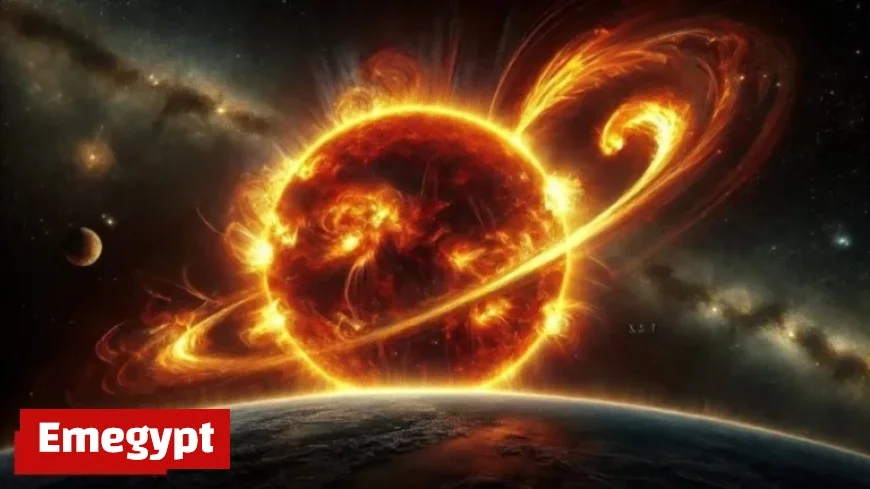
A solar flare with a classification of M5.9 occurred on Friday evening, as announced by the NOAA Space Weather Prediction Center (SWPC). This event took place at 22:22 UTC and originated from a newly discovered sunspot group on the Sun’s eastern limb.
Impact of the M5.9 Solar Flare
The solar flare achieved an R2-Moderate status on the radio blackout scale. While M-class flares are characteristic during periods of heightened solar activity, such powerful flares are less common than their lower-level counterparts.
Detection and Observation
The eruption was documented using SUVI 131 Angstrom imagery from the GOES-19 satellite. This imagery revealed a bright and impulsive burst at the eastern edge of the Sun. NOAA notes that M-class flares generally exhibit rapid rise and fall within short timeframes, although some can last longer based on the dynamics of the active region.
Immediate Effects of the Solar Flare
The M5.9 solar flare caused several immediate effects:
- Brief degradation or loss of high-frequency (HF) radio communications.
- Potential disruptions for aviation and marine operations.
- Interference for amateur radio users.
These disruptions typically last only a few tens of minutes.
Future Monitoring and Possible Geomagnetic Storms
NOAA analysts are assessing whether the flare has produced a coronal mass ejection (CME). A CME directed toward Earth could increase the likelihood of geomagnetic storms, especially if it carries south-pointing magnetic fields. Currently, no CME has been confirmed.
Ongoing Solar Activity
The sunspot group responsible for the M5.9 flare is still rotating into view on the Earth-facing side of the Sun. This indicates the possibility of further solar activity in the days to come. NOAA will provide updates as new imagery and solar wind data become available.