


















Bitcoin Faces Bearish Global Growth Outlook Since COVID and FTX Crash: Bitwise Study Finds

Bitcoin is grappling with a bearish outlook for global growth as highlighted by recent research from Bitwise Asset Management. This assessment indicates that the leading cryptocurrency may be anticipating an economic recession, despite positive macroeconomic signals.
Bitcoin’s Current Market Sentiment
André Dragosch, the European Head of Research at Bitwise, shared insights on social media regarding Bitcoin’s price behavior. He stated that Bitcoin is reflecting the most negative global growth expectations since the 2022 Federal Reserve’s tightening measures and the COVID-19 crisis in 2020.
Analysis of Growth Expectations
Utilizing macro survey data from reputable sources such as Sentix, ISM, and the Philadelphia Fed, Dragosch produced a chart that highlights a significant divergence. The chart compares Bitcoin’s implied growth outlook, represented by a line that has dropped below -1 standard deviation, to traditional macroeconomic indicators, which remain close to neutral.
- Bitcoin’s implied growth outlook indicates a pessimistic stance.
- Traditional economic indicators are currently neutral.
Dragosch noted that this scenario is reminiscent of previous major market events, specifically in March 2020 and November 2022, just prior to Bitcoin’s noteworthy price surges. He described the current risk-reward scenario as asymmetric and indicated that market sentiments may not reflect the potential for recovery. He suggested that a resurgence could mirror the sixfold rally witnessed after the COVID-induced financial shock.
Current Market Conditions
The sentiment within the cryptocurrency market remains delicate. The CMC Crypto Fear and Greed Index recorded a steady score of 20, classified as “Fear,” which is slightly above the year-to-date low of 10 noted in late November. In comparison, the index recorded a score of 39 just one month ago and peaked at 84 (“Extreme Greed”) in late November 2024.
Bitcoin’s Price Performance
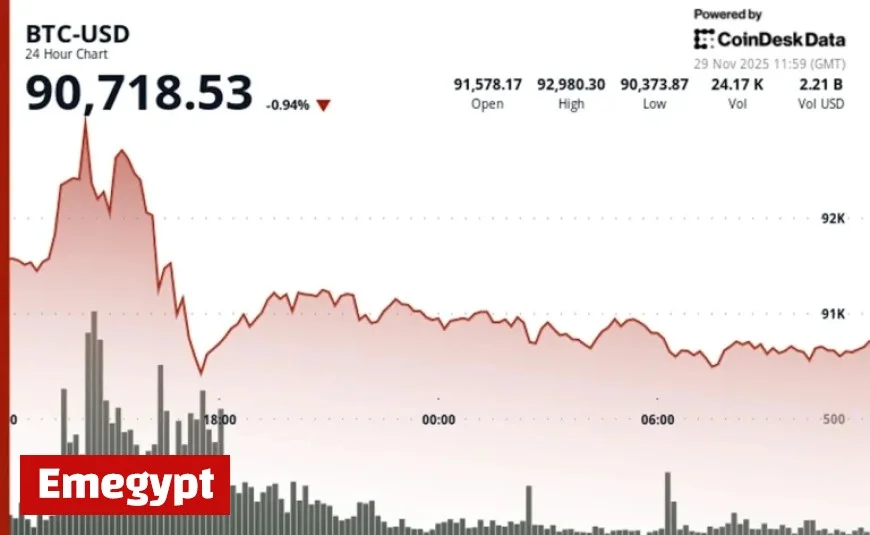
As of 11:30 a.m. UTC on November 29, Bitcoin’s trading price stood at $90,559, reflecting a decline of 0.8% within the previous 24 hours. Over the year, the cryptocurrency has depreciated by 3% and is down 28% from its all-time high of $126,080, achieved on October 6.
Implications for Federal Reserve Policy
The macroeconomic landscape appears to be evolving. The CME FedWatch Tool indicates that traders anticipate an 86.4% probability of the Federal Reserve lowering its benchmark interest rate by 25 basis points during its upcoming December policy meeting, potentially adjusting the rate to a range of 3.5% to 3.75%.
In conclusion, Bitcoin’s current bearish outlook reflects broader economic fears, while market dynamics continue to shift. Investors and analysts alike are closely monitoring these developments as they unfold.