


















NeurIPS 2025 Highlights Best Papers with Comics

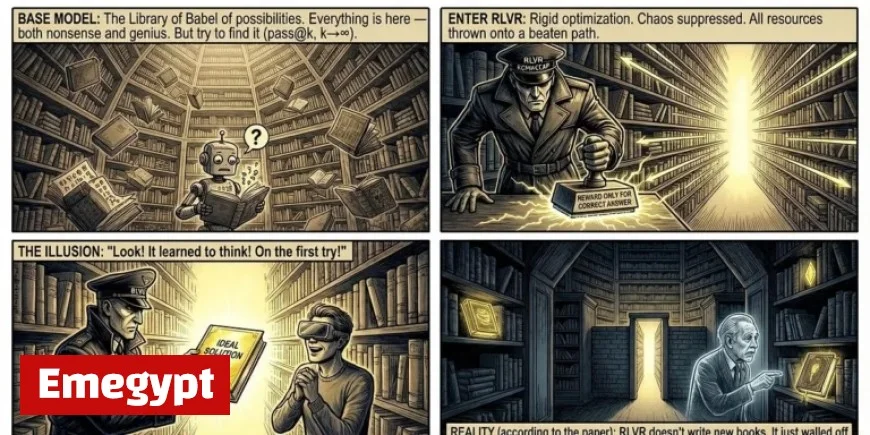
The NeurIPS 2025 conference recently announced its Best Paper Awards, highlighting several groundbreaking research contributions in artificial intelligence and machine learning. This year, a unique approach was taken by generating comics to visually explain some of the winning papers, enhancing accessibility and engagement with complex ideas.
NeurIPS 2025 Best Papers Highlighted
INFINITY-CHAT: Evaluating Output Diversity in LLMs
- Authors: Liwei Jiang, Yuanjun Chai, Margaret Li, Mickel Liu, Raymond Fok, Nouha Dziri, Yulia Tsvetkov, Maarten Sap, Yejin Choi
- Paper:INFINITY-CHAT
- Key Findings: A dataset of 26,000 real-world queries was developed to assess diversity among over 70 LLMs.
This study revealed an “Artificial Hivemind” effect where models frequently produce similar outputs, undermining the assumption that model ensembles ensure diversity.
Gated Attention: Enhancing Model Performance
- Authors: Zihan Qiu, Zekun Wang, Bo Zheng, et al.
- Paper:Gated Attention
- Contribution: A new attention mechanism that introduces input-dependent gating, improving training stability and perplexity across various models.
The innovation effectively mitigates loss spikes and enhances long-context extrapolation, indicating significant advancements in training methods.
Scaling Reinforcement Learning Policies
- Authors: Kevin Wang, Ishaan Javali, Michał Bortkiewicz, et al.
- Paper:Scaling Reinforcement Learning
- Achievement: Successfully scaled RL policies to over 1,000 layers using Self-Supervised Learning techniques.
This work demonstrates the potential of deeper networks in reinforcement learning, challenging past beliefs about the limitations of depth in RL.
Understanding Diffusion Models
- Authors: Tony Bonnaire, Raphaël Urfin, Giulio Biroli, et al.
- Paper:Why Diffusion Models Don’t Memorize
- Insight: Analysis of training dynamics reveals why overparameterized models can generalize effectively.
The researchers established that careful model training and “early stopping” proves essential for preventing memorization and fostering generalization.
Probing Large Language Models’ Reasoning Boundaries
- Authors: Yang Yue, Zhiqi Chen, Rui Lu, et al.
- Paper:Reasoning Boundaries of LLMs
- Key Finding: Reinforcement Learning with Verifiable Rewards enhances efficiency but does not expand the reasoning capabilities of models.
This study suggests that RL methods are limited by the foundational capabilities of pre-trained models.
Transductive Online Learning Breakthrough
- Authors: Zachary Chase, Steve Hanneke, Shay Moran, et al.
- Paper:Mistake Bounds in Learning Theory
- Contribution: Established tight mistake bounds for Transductive Online Learning, addressing long-standing problems in the field.
The findings demonstrate significant advantages in predictive performance, refining our understanding of optimal learning strategies.
Explaining Neural Scaling Laws
- Authors: Yizhou Liu, Ziming Liu, Jeff Gore
- Paper:Superposition Scaling
- Insight: Linking neural scaling laws to representation superposition provides a foundation for understanding model performance.
This research reveals that feature representation dynamics are crucial to the scaling behavior of large models.
The NeurIPS 2025 conference has illustrated the dynamic evolution of AI through these innovative studies. Each paper contributes significantly to expanding the boundaries of knowledge in machine learning and artificial intelligence.