















Republicans Plan to Divide Marion County into Four Congressional Districts

Indiana lawmakers convened on a recent Monday to discuss a proposal that would reshape the state’s congressional districts. The plan aims to diminish the influence of Democrats in the state, currently held by seven Republicans and two Democrats. The proposal specifically targets the 1st District, represented by U.S. Rep. Frank Mrvan, and the 7th District, represented by U.S. Rep. André Carson, both of which are positioned in northwest Indiana and Marion County, respectively.
Proposed Redistricting Plan
The Republicans’ redistricting proposal would divide Marion County into four separate congressional districts. This change intends to dilute the concentration of Democratic voters, thereby increasing the Republican advantage. U.S. Rep. André Carson criticized the plan, stating, “Splicing our state’s largest city into four parts is ridiculous.” He emphasized that these proposals come from outside influences and disregard local community needs.
State and National Context
The redistricting discussions in Indiana reflect a broader national trend. Many states, driven by both Democratic and Republican leadership, are revising their congressional maps in preparation for the midterm elections. Indiana’s House Republican leadership cited changes in states like Virginia, California, and Missouri as inspiration for their actions.
Speaker Todd Huston (R-Fishers) highlighted the national attention influencing local decisions. He noted, “Indiana is not acting in a vacuum.” Huston expressed that California’s recent redistricting had a significant impact on Indiana’s approach. Following the session, him and other Republican leaders reported productive discussions with U.S. House Speaker Mike Johnson regarding the redistricting efforts.
Public Opposition and Intrusions
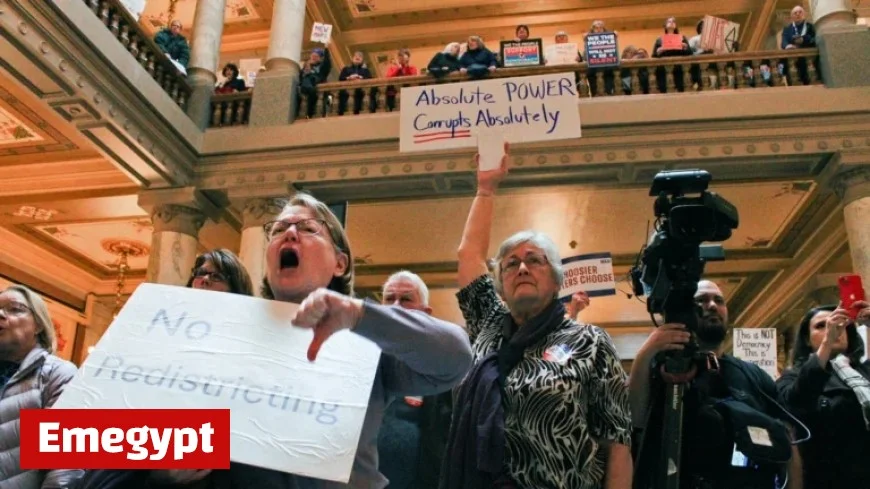
As lawmakers debated the proposed maps, hundreds of Hoosiers gathered to oppose the redistricting changes. Chants of “Just Say No” and “Shame On You” resonated through the statehouse. Local resident Becky Sutton voiced her frustrations with out-of-state influences dictating local politics, emphasizing that the proposed plan is unjust.
Some lawmakers reported receiving anonymous threats during this contentious debate, as well as swatting incidents, where law enforcement was falsely alerted for domestic violence claims. This climate of fear highlights the tensions surrounding the redistricting discussion.
Concerns Raised by Lawmakers
Democratic lawmakers voiced strong objections to the proposed map. Rep. Cherrish Pryor pointed out the violation of House rules due to the rushed sessions and highlighted the importance of constitutional oaths. Rep. Edward Delaney expressed apprehension regarding the impact on racial minorities, questioning the intentions behind the map.
Political experts suggest that legal challenges could emerge, particularly concerning racial gerrymandering. Political science professor Dr. Laura Merrifield Wilson indicated that while political gerrymandering is often legally accepted, challenges focusing on racial distribution might carry weight.
Impacts on Democracy
Critics, including political science professor Gregory Shufeldt, argue that these redistricting plans could adversely affect Indiana’s democracy. He warned that reducing competition in elections and diluting the influence of minority voters diminishes overall voter engagement.
As the redistricting bill moves through the legislative process, lawmakers are bracing for potential challenges ahead. The efficacy and fairness of these proposed maps will likely continue to be a topic of significant debate in the weeks to come.