














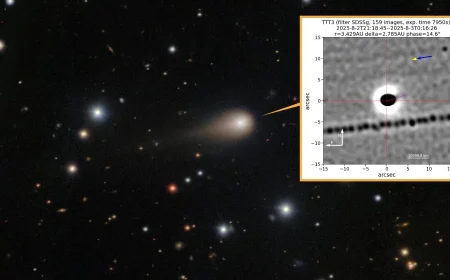



New Images Reveal Interstellar Comet 3I/ATLAS Erupting with Ice Volcanoes

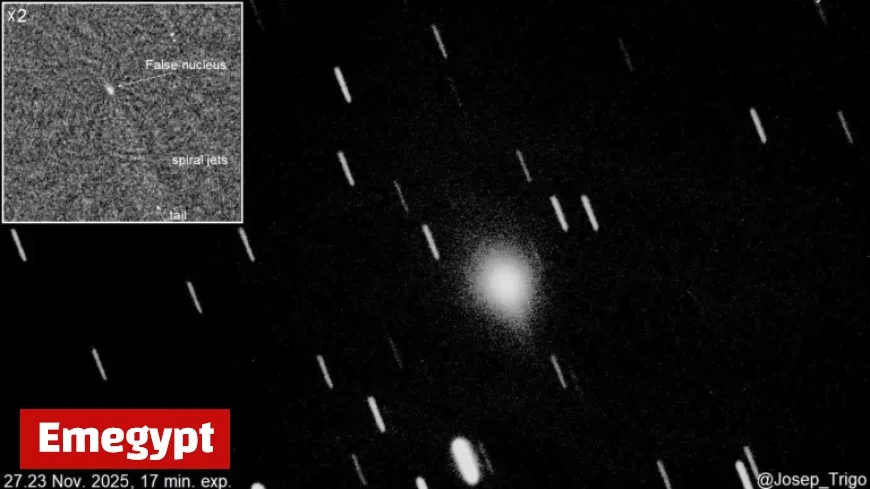
New imagery has unveiled that interstellar comet 3I/ATLAS may host active cryovolcanoes, revealing a remarkable aspect of this celestial object. As the comet neared the sun, researchers observed icy jets erupting, indicating cryovolcanic activity on its surface. This finding could reshape our understanding of the comet and its origins.
Investigating Cryovolcanism on Comet 3I/ATLAS
A study published on November 24 on the preprint server arXiv indicates that 3I/ATLAS resembles icy trans-Neptunian objects, challenging previous assumptions. The lead researcher, Josep Trigo-Rodríguez from the Institute of Space Sciences in Spain, expressed surprise at the comet’s surface material resembling those from our solar neighborhood.
Comet Origins and Characteristics
Since its discovery in July, comet 3I/ATLAS has sparked discussions about its origins, including unsubstantiated theories about extraterrestrial spacecraft. However, astronomers largely agree it is a comet from an unknown star system. As the third recorded interstellar object, it presents an exceptional opportunity to study conditions beyond our solar system.
- Discovery Date: July 2023
- Closest Approach to Sun (Perihelion): October 29, 2023
- Distance from the Sun During Study: 235 million miles (378 million kilometers)
- Theoretical Age: Possibly over 3 billion years
- Speed: Approximately 137,000 miles per hour (221,000 kilometers per hour)
Observational Techniques and Findings
Using the Joan Oró Telescope at Montsec Observatory, researchers documented the comet’s increasing sublimation activity as it approached the sun. The comet brightened noticeably, providing high-resolution images of gas and dust jets interpreted as signs of cryovolcanism.
These cryovolcanoes are believed to be caused by internal heat melting ice within the comet, releasing vapor and dust into space. This phenomenon has been commonly linked to planetary bodies rich in ice, such as those beyond Neptune.
Comparative Analysis with Other Celestial Bodies
To validate their hypotheses regarding the comet’s composition, researchers conducted a spectroscopic analysis comparing 3I/ATLAS to primitive meteorites known as carbonaceous chondrites. This comparison revealed similarities in material, suggesting that the comet could provide clues to the early days of our solar system.
- Potential Size: Between 1,400 feet (440 meters) and 3.5 miles (5.6 kilometers) wide
- Estimated Mass (if 0.6 miles wide): Over 660 million tons (600 million metric tons)
Importance of Studying Interstellar Comets
Comet 3I/ATLAS emphasizes the need for careful observation of interstellar objects due to their potential impact on Earth. Trigo-Rodríguez noted that these comets are essential for understanding cosmic history and chemistry, akin to “space capsules” that could hold valuable information on the formation and evolution of planetary systems.
The study of comet 3I/ATLAS signifies how even a brief glimpse into the history of interstellar bodies can illuminate aspects of our universe yet to be fully understood.