

















Paleozoic Black Mesas Create Rare Sahara Sand Dunes from Space

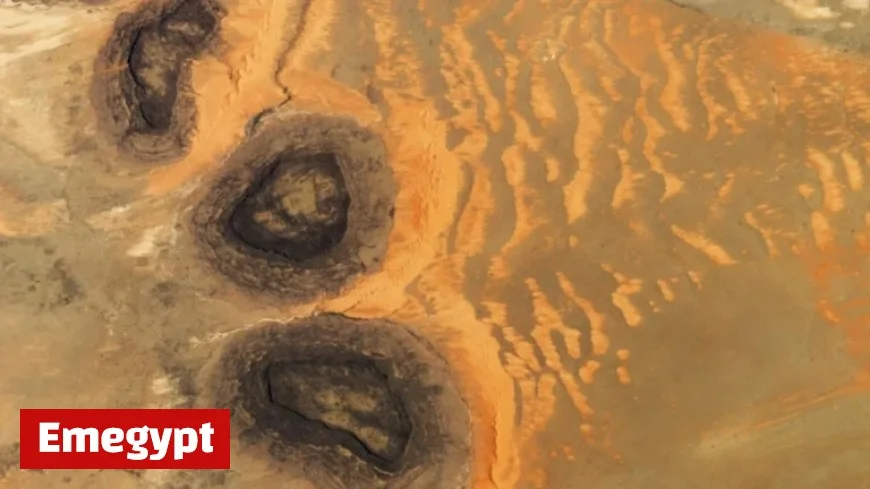
The striking landscapes of the Sahara Desert have drawn attention from space. A recent photograph captured by an astronaut on the International Space Station (ISS) showcases three ancient black mesas nestled in this vast arid region. The image, taken on May 3, 2023, highlights the unique formations and their ecological impact.
Paleozoic Black Mesas in Mauritania
The black mesas are situated near Guérou, Mauritania, approximately 8 miles (13 kilometers) northwest of the town. This town is home to around 22,000 residents. Rising steeply from the surrounding plains, these mesas reach elevations between 1,000 and 1,300 feet (300 to 400 meters), with the largest measuring about 6 miles (9.5 kilometers) across at its widest point.
Formation and Characteristics
The dark hue of the mesas results from a natural phenomenon known as “rock varnish.” This clay-based coating, rich in manganese and iron oxides, forms over thousands of years on arid rocks. Microorganisms may have contributed to stabilizing this layering, which consists of several micrometer-thick laminations.
A notable feature of this landscape is the presence of a dune-free zone to the west of the mesas, contrasted by sizeable sand dunes to the east. The wind primarily blows from the east, carrying sand towards the mesas’ sloped sides, leading to two distinct types of dunes:
- Climbing Dunes: These ridge-like structures are larger and rest along the eastern walls of the mesas.
- Barchan Dunes: More common, these crescent-shaped dunes extend from the mesas, creating a striking visual effect with their reddish-yellow hues.
Wind scour prevents sand accumulation on the western side due to rapid vortices that clean the area between the mesas. This unique interaction has allowed for the unusual dune formations observed in the photograph.
Geological History
These black mesas likely originated during the Paleozoic era, which spanned from 541 million to 251.9 million years ago. Over time, erosion from water and wind fragmented a once-massive rock formation into the mesas we see today. The phenomena observed today may connect to larger geological structures, similar to the Richat Structure, also found in Mauritania, approximately 285 miles (460 kilometers) north of Guérou.
Global Context of Mesas
Mesas occur worldwide, but notable concentrations are found in the Sahara and parts of the United States, including Colorado, New Mexico, Utah, and Arizona. Interestingly, Mars also features mesas, shaped by billions of years of wind erosion.
This captivating view from space not only highlights the beauty of the Sahara landscape but also tells a story of geological processes that have shaped our planet and beyond.