
















Rock Formations Uncovered in Sahara Desert

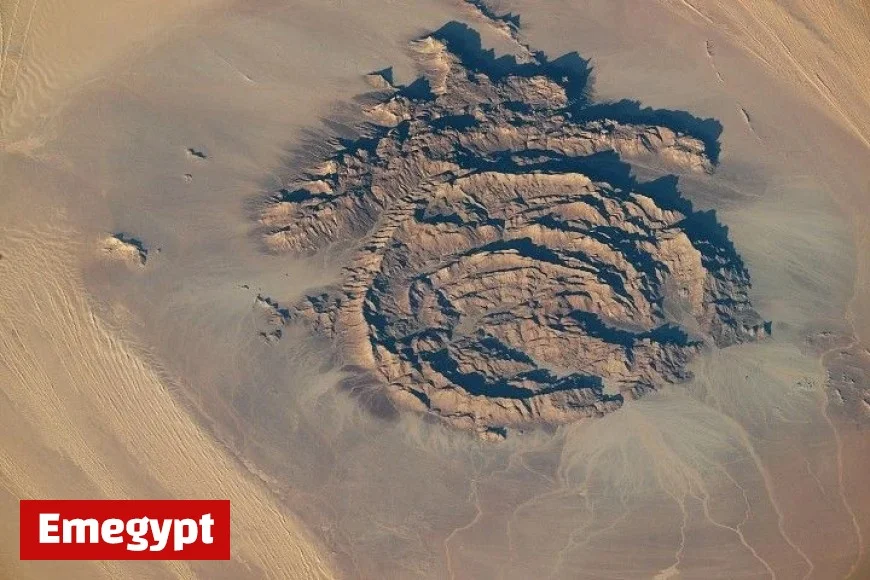
The Sahara Desert, known for its expansive dry landscapes, hides a remarkable geological feature in its northeastern section. Dark rocky formations, particularly Jabal Arkanū, stand out in this arid environment. These formations display intriguing ring-shaped structures that have captivated researchers and geologists.
Key Geological Features of Jabal Arkanū
Jabal Arkanū, located in southeastern Libya near the border with Egypt, hosts several other significant massifs. Among them is Jabal Al Awaynat, approximately 20 kilometers southeast of Arkanū. Also noteworthy are similarly named Arkenu structures, found around 90 kilometers to the west.
Circular Structures Fuels Research
Initially, scientists believed these circular features were caused by meteorite impacts. However, subsequent research indicated a different origin, rooted in terrestrial geological processes. It is now understood that the ring formations at Arkanū were created when magma rose towards the surface and intruded into the surrounding rock layers. This process led to a series of overlapping rings, forming a complex with its centers oriented roughly southwest.
Composition and Landscape
The ring complex is primarily composed of igneous basalt and granite. To the north, a hat-shaped formation distinguished by sandstone, limestone, and quartz layers adds to the unique landscape. The massif rises nearly 1,400 meters above sea level, or about 800 meters above the surrounding sandy plains, creating a stunning geological contrast.
- Elevation: Approximately 1,400 meters above sea level
- Structural Composition: Igneous basalt, granite, sandstone, limestone, quartz
- Nearby Landmarks: Jabal Al Awaynat (20 km southeast)
Rainfall Data and Climatic Conditions
This region receives minimal rainfall, with averages between 1 to 5 millimeters annually, according to research from NASA and JAXA’s Tropical Rainfall Measuring Mission (TRMM). The areas around Jabal Arkanū may see slightly higher precipitation levels, around 5 to 10 millimeters per year, possibly due to orographic effects from the mountains.
Astronaut Photography Highlights
A stunning photograph captured by an astronaut aboard the International Space Station on September 13, 2025, shows Jabal Arkanū casting elongated shadows over the desert. The image demonstrates the vastness and intricate details of the massif and its surrounding geographical features.
As research continues, Jabal Arkanū and its circular formations remain a focal point for geological studies, providing insights into the Earth’s geological history and climatic patterns in one of the world’s most extreme environments.