

















Discover Why the UN’s Asteroid Warning Network is Monitoring Comet 3I/ATLAS Closely

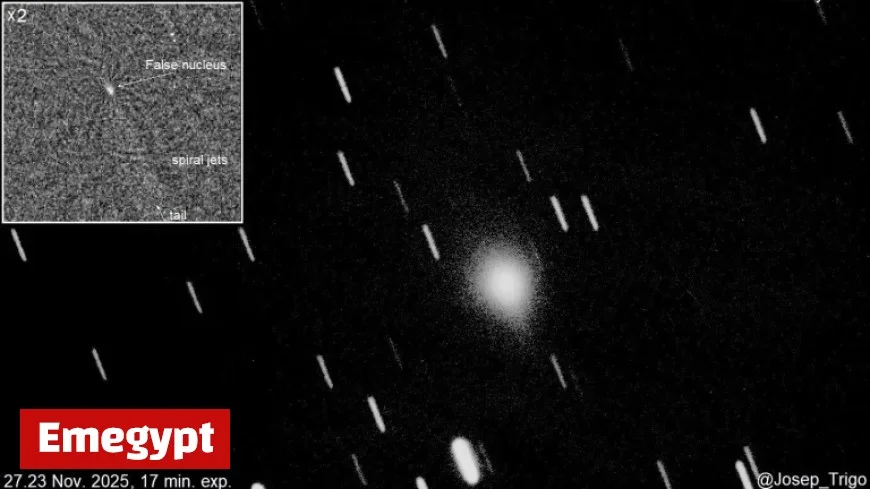
The interstellar comet 3I/ATLAS is currently the focus of an extensive monitoring effort, particularly by the United Nations’ International Asteroid Warning Network (IAWN). This comet is anticipated to make its closest approach to Earth on December 19, coming within approximately 167 million miles (270 million kilometers) of our planet.
Monitoring Efforts for Comet 3I/ATLAS
As part of a global initiative, telescopes worldwide are tracking 3I/ATLAS. The aim is to collect data on its trajectory and enhance predictions for similar celestial objects in the future. The monitoring campaign, which is about halfway completed, is expected to yield findings published in a peer-reviewed journal next year, according to James Bauer, a principal investigator at IAWN.
Collaboration and Research
The IAWN consists of over 80 observatories and citizen scientists dedicated to researching near-Earth objects like asteroids and comets. NASA coordinates this network’s observing campaigns. Notably, 3I/ATLAS is the first interstellar object being monitored since the IAWN’s campaigns began in 2017.
- The potentially hazardous asteroid Apophis was observed in 2020 and 2021.
- A new campaign for Apophis is planned between 2027 and 2029, as it approaches Earth safely.
Bauer emphasizes that the primary goal of these campaigns is to enhance technical abilities in measuring celestial positions through astrometry. This particular campaign is not only crucial for 3I/ATLAS but also sets a precedent for future missions that may target similar comets.
Challenges of Tracking Comets
Tracking a comet poses challenges, particularly due to variations in brightness and the comet’s coma, a cloud of gas and dust surrounding it. These factors can alter the apparent size of the comet, complicating its location tracking. However, 3I/ATLAS exhibits typical cometary behaviors, including the presence of water and carbon dioxide, leading Bauer to refer to it as a “comet’s comet.”
Community Engagement
The response from the astronomical community has been overwhelmingly positive. When the IAWN campaign for 3I/ATLAS launched in October, it attracted a record 171 participants. As of December 9, mid-campaign meetings still engaged about 100 participants.
Bauer and his team have been actively responding to queries from the community regarding observation techniques and data reporting. This involvement not only aids astronomers in refining their observational skills but also strengthens vigilance regarding other near-Earth objects.
Conclusion
The monitoring of Comet 3I/ATLAS by the UN’s IAWN underscores the collaborative efforts needed to understand and track celestial bodies. With its upcoming close approach, this campaign serves as a vital step in advancing our knowledge of interstellar objects and enhancing our preparedness for future encounters.